
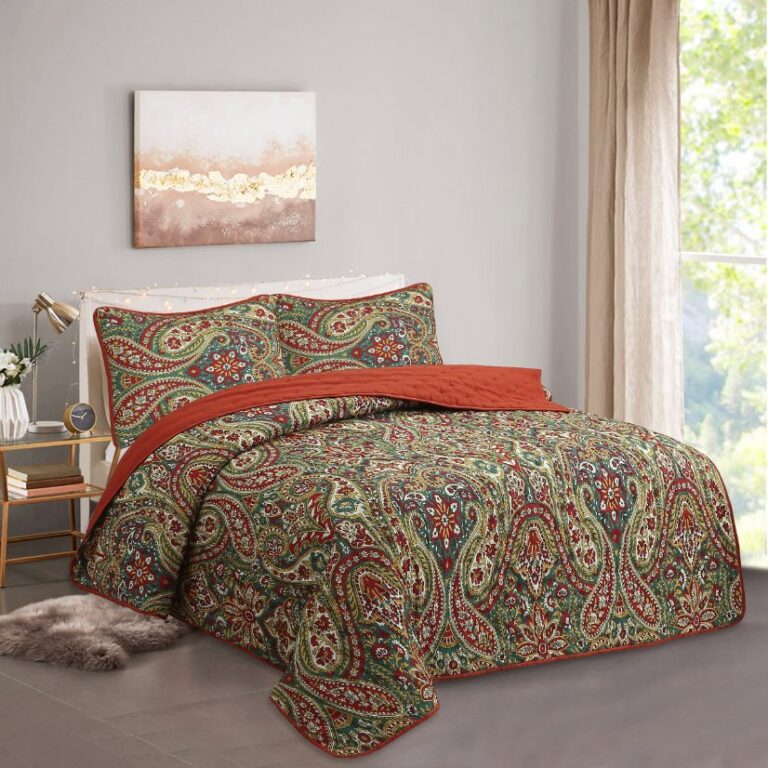
A quilt size RFQ should state the requested finished dimensions, their units and the measurement state the supplier is being asked to confirm. Keep the catalogue size label separate from those dimensions. Ask how the sample will be positioned, which directions are called length and width, and whether the quoted dimensions refer to the item before or after an agreed treatment. A styled bed image cannot answer those questions or guarantee the overhang shown in a room scene.
Use the catalogue label as a reference, not a measurement
Huawuque Digital displays an A02 paisley bedspread reference alongside other printed bedding designs. Its product URL helps a buyer identify the item under discussion. A catalogue size name, however, should not be substituted for the dimensions requested in a purchase inquiry. Ask the supplier which size designation applies to the proposed item and keep that designation beside the actual dimensions it confirms.
Size names used by different purchasing teams do not automatically describe the same finished item. An international buyer should therefore record the unit and the direction of each dimension, while preserving the supplier’s original item and size codes. If the buyer requests a configuration different from the catalogue reference, mark it as a request awaiting confirmation rather than treating it as an available standard option.
Describe the state in which a size applies
A dimension can become ambiguous when the buyer and supplier are referring to different states of the item. Ask whether the quoted figure describes the finished supplied quilt, another production reference or a sample after an agreed treatment. Do not assume that a care instruction or a general product description supplies a measurement protocol. The applicable state should be written into the response for the specific offer.
Keep any treatment-related request separate from a claim about expected behavior. For example, if a buyer needs a measurement after a particular agreed process, ask the supplier whether it can provide that information and how it would be recorded. Do not insert an assumed dimensional change, a shrinkage allowance or a test result. Those values and procedures require a supplier response and an agreed basis.
Put the measurement questions in the RFQ
The following table helps the buyer distinguish a required answer from an assumed specification. It does not define the sizes currently supplied by Huawuque Digital or prescribe a testing standard. Use it to request the supplier’s applicable dimensions and measurement description for the identified item.
RFQ field | Buyer should specify | Supplier should confirm
Item and version | Catalogue link and requested version | Exact offered reference
Dimension names | Which direction is length and width | Corresponding points on a drawing or sample
Units | Unit required in the order record | Unit used in the quoted dimensions
Measurement state | State the buyer wants documented | Applicable state and method
Acceptance basis | Any proposed requirement needing discussion | Agreed method and applicable limits
Size designation | Buyer label and original supplier label | Mapping between the labels and confirmed dimensions
Do not estimate dimensions from the room scene
The selected paisley scene shows a bed covering draped over a bed, with a turned-back area near the pillows. It is useful for identifying the appearance being discussed. The photographed bed dimensions, the arrangement of the covering and the viewpoint are not established by that image. An apparent edge position should not become a specified overhang or a substitute for the supplier’s finished dimensions.
If the purchasing decision depends on a particular presentation, provide the relevant buyer reference separately and ask the supplier to respond to it. Distinguish the buyer’s intended use from the item dimensions the supplier actually confirms. A similar catalogue photograph does not demonstrate compatibility with a particular bed, mattress arrangement or room display. Keep those assumptions outside the confirmed specification until the parties have reconciled them.
Connect the sample record to the purchase line
When the sample is reviewed, retain the sample identifier, the measurement description and the supplier’s size reference together. A recorded figure without its measurement state can be difficult to compare with a later sample. If the buyer finds a difference, first ask whether the same item, state, unit and direction were used before interpreting that difference as a confirmed specification change.
Before confirming the purchase, reconcile the approved sample reference with the dimensions and size designation on the offer. Keep any unanswered acceptance question visible. Do not invent a permissible variation simply to complete a form. Current prices, order minimums, availability, delivery terms and product performance remain separate supplier matters. A clear size RFQ improves the purchasing record without making unsupported promises about the finished product.
• Record dimensions with units and direction labels.
• Specify which item state the measurement is intended to describe.
• Keep a catalogue size name linked to the supplier’s confirmed figures.
Frequently asked questions
Can a size name replace finished dimensions in an RFQ?
Use the name as a reference and ask the supplier for the corresponding dimensions and units. Keep the original designation visible so that translated or buyer-specific labels do not silently change the item being discussed.
Should the buyer assume a standard dimensional allowance?
No. Ask the supplier to discuss the required acceptance basis and record the agreed method and limits. A number borrowed from another item or an earlier order is not a confirmed term for the current offer.
Does the catalogue photo establish the bedspread’s overhang?
No. The bed, positioning and viewpoint in the scene are not a dimensioned purchasing drawing. Request the finished item dimensions and discuss any buyer-specific presentation requirement separately.
What should be recorded if two sample measurements differ?
Check the item reference, units, dimension direction and measurement state before drawing a conclusion. Keep both observations with their context and request clarification where needed. Do not treat a comparison made on different bases as a verified product change.
Product and contact references
Catalogue reference: confirm matching item: https://hwqdigital.com/product/a02-adult-bohemian-paisley-super-soft-polyester-quilt-160g-imitation-silk-ultrasonic-bedspread/
Related catalogue reference: https://hwqdigital.com/product/a01-blossom-fortune-digital-printed-quilt/
Contact Huawuque Digital: https://hwqdigital.com/contact/
Huawuque Digital blog: https://hwqdigital.com/blog/