
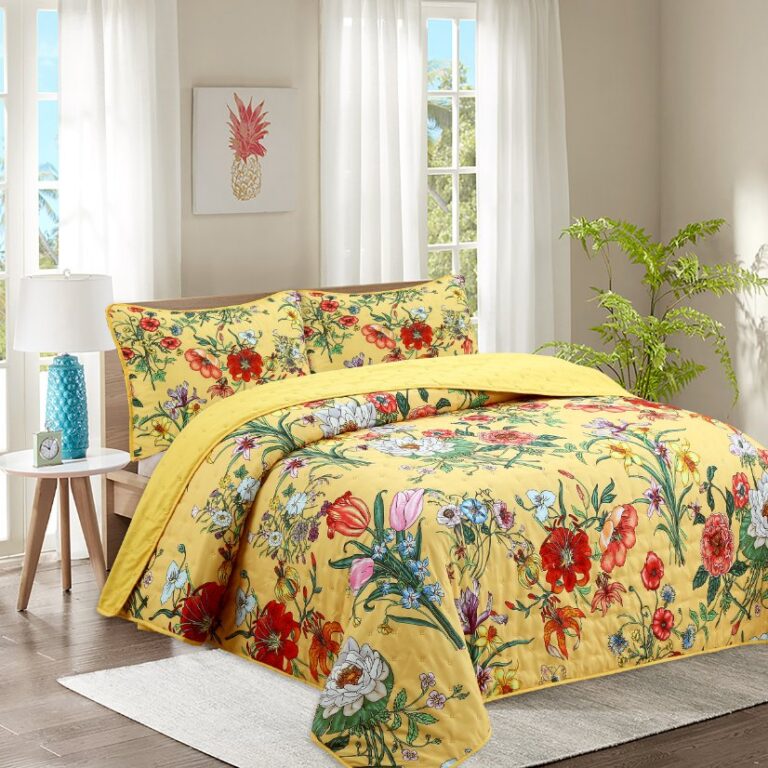
A printed quilt artwork RFQ should identify the intended face, the reverse and the viewing direction as separate references. Send the catalogue product URL, mark the areas you want the supplier to confirm, and request an artwork revision tied to the exact offered item. A folded showroom photograph can help identify a design, but it cannot establish the complete reverse, the final print placement or which matching accessories are included in an order.
Name the item before describing the artwork
Huawuque Digital lists an A01 Blossom Fortune Digital Printed Quilt. Its product page and floral catalogue scene provide a concrete starting point for a buyer inquiry. Keep that product reference beside the selected image. Descriptions such as the yellow floral one become unreliable when several colleagues exchange screenshots or when a supplier presents another color interpretation of a similar pattern.
Start the RFQ with the exact catalogue reference and ask the supplier which offered version it represents. Then add the buyer’s artwork reference, if one exists. The catalogue item, the buyer’s design file and the supplier’s proposed revision serve different purposes. Keeping their identifiers separate makes it easier to see whether the discussion concerns an existing design, a requested adaptation or an alternative that still needs approval.
Keep the visible face and folded area separate
The selected floral scene shows a large patterned surface and a turned-back area near the head of the bed. Use those visible areas to ask a precise question about the proposed face and reverse. Do not treat the small folded view as a complete image of the opposite side. Ask for an additional view or supplier explanation when the full reverse is relevant to the artwork decision.
Avoid assuming that every item placed in the room carries the same approved print. Pillow-like objects may be part of the styling rather than the offered product. The A01 page describes the package as a single quilt, so a buyer should obtain separate confirmation before requesting matching pieces as supplied items. An artwork approval should identify each proposed component instead of extending the quilt’s approval to everything pictured nearby.
Create a small artwork reference map
A reference map gives the supplier a clear place to answer each question. It also helps the buyer retain the meaning of an image after it is forwarded to another office. Use pending confirmation where an area has not been shown. Do not replace a missing view with an assumption taken from a different catalogue design.
Artwork area | Buyer reference | Supplier confirmation requested
Main face | Selected product image and artwork identifier | Exact proposed printed face
Reverse | Separate requested view or written requirement | Actual reverse appearance for the offered version
Viewing direction | Clearly labeled top and bottom reference | Orientation used in the proposed artwork
Edge area | Marked area needing clarification | Relationship between pattern and finished boundary
Other pieces | Individually identified requested components | Whether each piece is offered and separately approved
Resolve placement questions without inventing tolerances
A styled bed photograph can show only part of a design. Some pattern areas may be folded, covered or hanging over an edge. Ask the supplier whether it can provide a fuller layout reference for the proposed item. If a particular motif position matters to the buyer, mark that requirement and ask how it will be represented in the sample or artwork response. The photograph alone should not become a promise of exact placement.
Record the drawing or artwork revision used in the discussion. When the supplier proposes a change, identify the affected area and request a corresponding updated reference. Do not invent a printing tolerance, an acceptable color difference or a production method from the picture. Any measurable acceptance requirement should be agreed with the supplier for the actual order, with the method and applicable limits stated explicitly.
Keep digital references and sample approval connected
For buyers and suppliers working in different countries, keep the original item code and artwork revision unchanged in translated messages. Describe the viewing direction in words as well as on the image. A screenshot without its original reference can lose important context when another team downloads, rotates or crops it. The purchasing record should point back to the complete agreed reference rather than relying on whichever thumbnail appears in a chat.
A digital approval and a physical sample approval should each state what they cover. If a buyer has approved only the face design, leave the reverse or accessory questions open until they are answered. Prices, order minimums, availability and delivery terms belong in the supplier’s current quotation. Artwork clarification does not establish a material specification, a care claim or performance of the finished quilt.
• Label the face, reverse and viewing direction separately.
• Keep matching-item requests independent of room styling.
• Retain the supplier’s applicable artwork revision with the approval.
Frequently asked questions
Does a turned-back corner confirm the entire reverse?
It shows the visible area in that particular photograph. Ask for a separate view or a written confirmation of the proposed reverse when its appearance matters. Do not infer the hidden surface from a small fold.
Are matching pillows included because they appear in the scene?
A bedroom scene does not establish package contents. The A01 page describes a single quilt, and any matching pieces should be requested and confirmed separately. Keep component identity distinct from the visual styling of the product photograph.
Can a buyer specify where an individual motif appears?
The buyer can state that requirement and ask the supplier how it can be represented and approved. The supplier’s response should identify the relevant artwork or sample. A catalogue image does not itself guarantee a placement tolerance.
What should remain pending before purchase confirmation?
Keep any unconfirmed face, reverse, orientation or component reference visibly open. Approve the exact reference supplied in the response, and obtain current commercial and product specifications separately rather than deriving them from the room scene.
Product and contact references
Catalogue reference: confirm matching item: https://hwqdigital.com/product/a01-blossom-fortune-digital-printed-quilt/
Related catalogue reference: https://hwqdigital.com/product/a02-adult-bohemian-paisley-super-soft-polyester-quilt-160g-imitation-silk-ultrasonic-bedspread/
Contact Huawuque Digital: https://hwqdigital.com/contact/
Huawuque Digital blog: https://hwqdigital.com/blog/